Showing posts with label Atumpan. Show all posts

Saturday, October 30, 2010

Adowa Music - Onyame Nkrabea Nwomkro


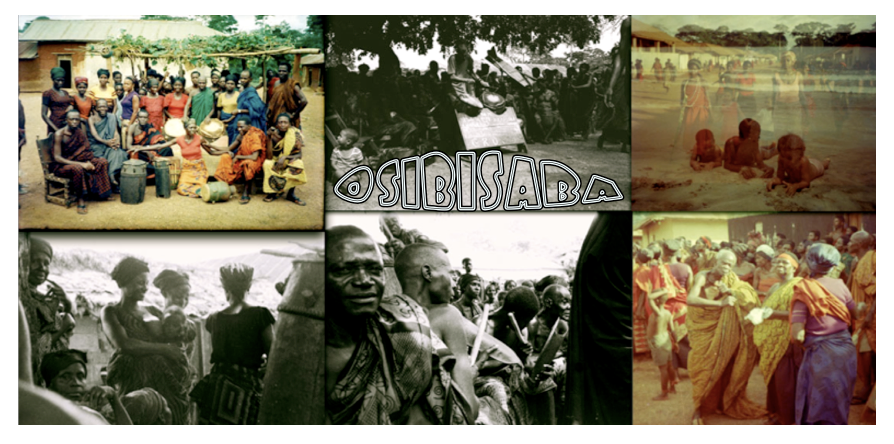
Moving away from popular music for the moment, I would like to present "Adowa," a traditional genre/dance of the Asante of Ghana.  Like other traditional music genres, Adowa combines drumming and percussion with dancing and call-and-response style singing. This music serves a profound social function, as Adowa is a dance that is performed at and often associated with funerals. Accordingly, song texts are frequently philosophical in nature, meditations on life, death, and humankind itself.

This particular recording by Onyame Nkrabea Nwomkro features three twenty-minute long tracks in medley style. The drummers maintain a minimal presence throughout, allowing the powerful chorus of singers to take the forefront. This music is beautiful and stunning, and I find myself totally absorbed in the complex melodic lines sung by the lead singers and the lead drummer's varied Atumpan phrases.


Please read below for some more detailed information on Adowa:


"The [Ensemble] includes one or two bells - dawuro (boat-shaped) or slit-type called adawuraa; one or two hourglass drums called donno; one sonorous drum played by the hand called apentemma; one tenor drum played with stick called petia; and a talking drum called atumpan.

With the exception of the bells which may be played by women, the rest of the instruments are played by men, while women form the chorus. Normally one of the bells is regarded as the 'primary' bell while the other bell functions as 'the bell that crosses.'

The hourglass drum plays something in simple duple thyrhms. Where there are two, the second one plays cross rhythm. The main function of the apentemma drums is to suply recurring high-pitched tones. The drummer works in patterns of low and high pitches. The basic rhythm of the peti is a simple 5-note phrase made up of alternating simple and duple rhythmic motif rather like the primary bell.

The atumpan is the most important of all the instruments in the ensemble. When the music starts, the drummer may first make an announcement of drums or give a short message of sympathy. Immediately after this, he may begin with first, the introductory rhythms, and then other rhythms follow, to give the dancer the opportunity to find his bearing or time. This could be followed by other rhythmic motifs, all these go to animate the dance."
- "African Music: Traditional & Contemporary," Alexander Akorlie Agordoh


The meaning of the word "Adowa" is interesting in itself. Adowa is the Asante name for the Royal Antelope (pictured right), one of the rarest and smallest of the antelope species (about the size of a house cat). This tiny animal is considered exceedingly graceful in its movements, and it is this type of graceful movement that Adowa dancers must imitate and express. The Adowa genre, then, is named after this small antelope.


I've already introduced the Atumpan drums briefly in this post. Played in pairs of two differently pitched drums, the Atumpan is used to express verbal phrases, proverbs, and appellations.  The experienced player is able to translate these speech patterns (many of which are set phrases) onto the Atumpan based upon the different tones of the Twi language.  In Adowa another layer of complexity is added. Here, the lead drummer plays set Adowa phrases on the Atumpan that correspond to specific dance actions. In effect, this drummer controls the dancers' steps and motions by playing through a commonly recognized repertoire of drum proverbs/phrases.

Thursday, September 16, 2010

I've Found My Love: 1960's Guitar Band Highlife of Ghana


John Storm Roberts' Original Music label released some fantastic, groundbreaking compilations of old African music from across the continent during the 1990s, so it's a shame that these CDs are now out of print and so difficult to find. I've Found My Love is, to me, one of the particularly special Original Music releases. Each one of these electric, guitar-band highlife tunes is more excellent than the last! Old-time greats like King Onyina and S.K. Oppong appear, along with other familiar names like Akompi, Akwaboa, and the Royal Brothers. If you enjoy this music check out Akom Ko (another similar compilation) over at Likembe, this one also featuring a few dance-band style tunes. 

Download I've Found My Love Here 

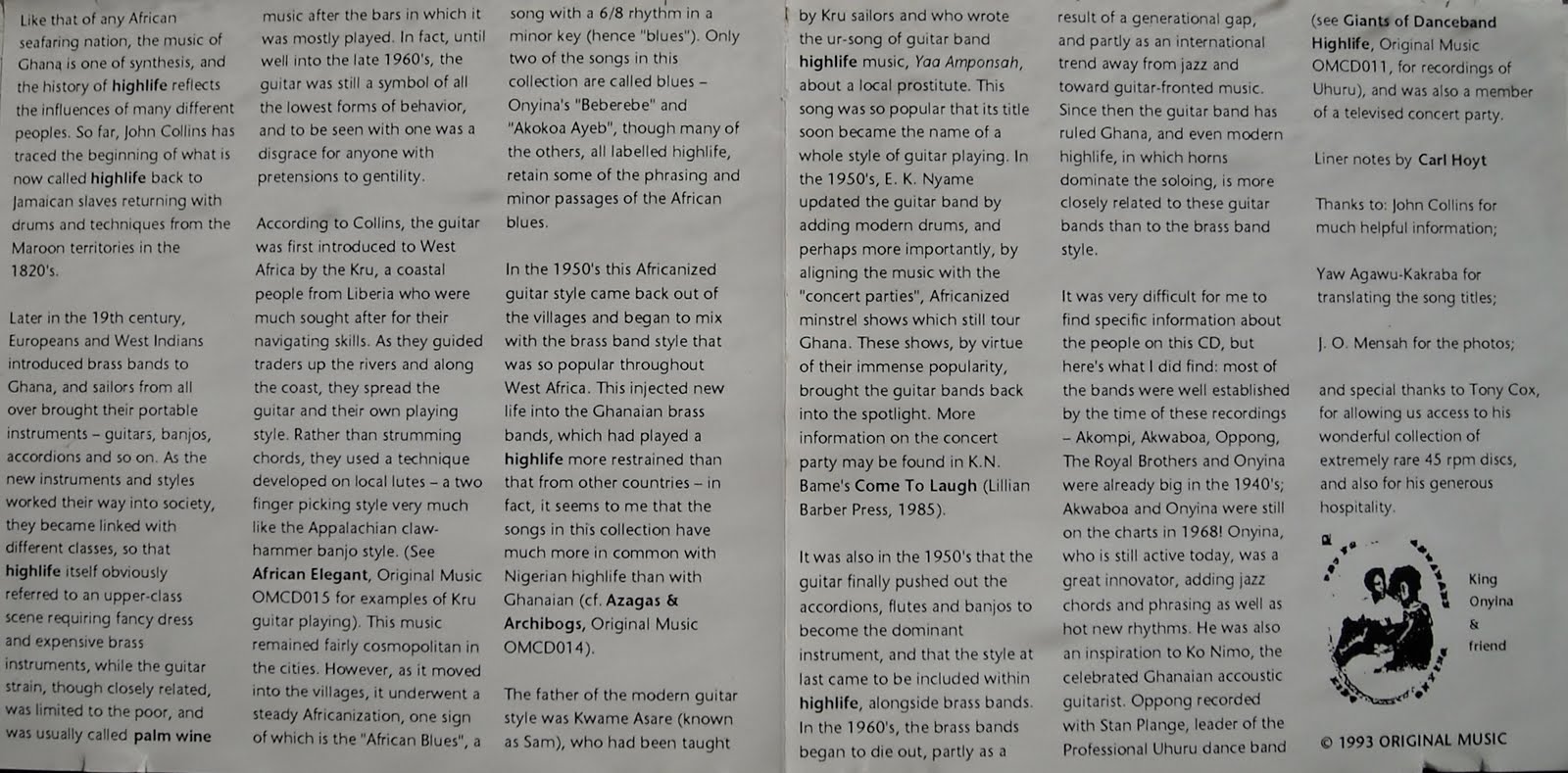
The liner notes included with I've Found My Love don't seem particularly well written in my opinion in terms of content and scope, but they're worth checking out for some general historical background on highlife if you'd like:


Also, I feel compelled to give brief mention of track eleven, Akompi's "Ose Obeko." This tune begins with a unique solo bass introduction that really strikes me each time I listen to it. Here, the bass (possibly an upright?) mimics the playing style of the Ashanti Atumpan drums (often referred to as "talking drums"). Played in pairs of two differently pitched drums, the Atumpan is used to express verbal phrases, proverbs, and appellations.  The experienced player is able to translate these speech patterns (many of which are set phrases) onto the Atumpan based upon the different tones of the Twi language (it should be noted that the Ga and Ewe do use the Atumpan as well in relation to their own languages). I think this example of Atumpan drumming translated onto a bass is rather remarkable, so I've included the track here for your listening: