Showing posts with label Akan. Show all posts

Monday, September 19, 2011

African Brothers Band - Have African Feeling


"Nana Ampadu wo he?" (Where is Nana Ampadu?) the Manager Rover Amo, asked Joe Dee. The time was exactly 7:45 a.m in that Summer morning. The recording was billed to commence at exactly 8 a.m., but Nana Ampadu I, the Leader, was not in the Studio. Rover Amo was wondering what had become of him. Donkor, Joe, Asare and others were discussing the issue. An unmistakable sign of dejection and consternation began to show up in their faces. The studio had been booked for only an hour and it was just a few minutes to 8 a.m. The studio manager had arrived, followed by the producer, Mr. Akie Dean. The instruments had been fixed and just as they were tunning their guitars, Nana strutted in, looking cheerful and feeling on top of the morning. 

"Me ma mo Akye ooh" Nana said, 
meaning (Good morning). Exhiliration filled in them and hilarious smile began to steal up in their faces. Nana strapped his guitar and fixed the wah-wah peddle. Rover Amo then whispered to Nana Ampadu, "Just give me a meddley LP, and give me the best, Okey?"


"Right, Amo" Nana Ampadu whispered back. Nana Ampadu turned to the Guys and enunciated,  

"You all know we are Africans, play with an African feeling, Okey?"

 
Mr. Akie Dean took his mic and the electronic device  b o o m e d .........


D o w n l o a d

Saturday, September 17, 2011

Koo Nimo Interview with Christopher Lydon & Radio Open Source


I've been on a bit of a Koo Nimo kick lately! If you have a chance, check out this fascinating 2010 interview with Koo Nimo by Christopher Lydon for Radio Open Source. The recording was made at "7:30 a.m. on the last Saturday in January, a warm winter morning in Ghana, and we are privileged to be hanging out for an hour of music and a few well-chosen words with a aristocrat of sound and four accompanists in his studio in Kumasi, the old Ashanti capital." Here, Lydon and Agya Koo discuss the history of highlife/palm wine music, jazz, globalization, the African diaspora, and musical cross-fertilization among other things. In addition, Koo Nimo offers some beautiful (although short) musical performances throughout the interview. I've made the performances alone available for download below.

Koo Nimo - Nwomkro Song

   Okomfo Anokye
Koo Nimo - Akomfo Anokye (Odonson)

Download interview performances

Tuesday, August 16, 2011

Palm Wine Music: Koo Nimo and Osei Korankye at Afrikafestival Hertme


This great 2008 performance by Koo Nimo at Afrikafestival Hertme in the Netherlands has been around Youtube for a while, and now we have another recently posted Youtube video which presents a more complete version of this performance. The always incredible Koo Nimo is joined here by members of his Adadam Agofomma group as well as the seprewa virtuoso Osei Korankye (whose collaboration album with Koo Nimo is available on this blog). The set begins with a seprewa/guitar piece "Abube ne atebe" that features Osei, followed by a beautiful song entitled "Death is everybody's business." The performance concludes with a version of the Ghanaian standard "Yaa Amponsah" that quickly turns into Koo Nimo's own tune "Aburokyire Abrabo" (Overseas Life). In case you're interested, I've posted a full recording of this tune below, along with a translation by Joe Latham from the booklet Ashanti Ballads of Koo Nimo.


On the subject of Koo Nimo, you might like to check out this beautiful, handmade book honoring Agya Koo that was recently acquired by the Smithsonian.  The book is called Listen, listen : Adadam Agofomma : honoring the legacy of Koo Nimo, a collaboration between artists Mary Hark, Atta Kwami, and Koo Nimo himself. An article about the book is on the Smithsonian site here.


Koo Nimo - Aburokyire Abrabo


Aburokyire Abrabo (Overseas Life)

Mother, Oh Mother, your son has made a terrible journey.
Now I am stranded overseas.
Darkness has encircled me.
There can be no witness to what I endure alone.

An unsuccesful mission is a disgrace,
So how can we come hone?
If you fail, no child is named after you.
Death is preferable to shame.

Everyone has reasons for leaving his native land.
Some travel to study, or to marry.
Some go as tourists, some look for jobs.
Some seek medical treatment.

Some return, but others die overseas.
What a tragedy that is.
Why should this be?
It is our individual destiny.
Life has its bad times we have to pass through.

The cold weather gets so bitter men lose their senses.
Poverty, family problems, illness and accidents
All aggravate the stranger's sad state.
Married or single, life is not pleasant in a foreign land.

Bad company, gossip, rumours, misunderstandings,
So many troubles could be settled by speaking to the family.
There is but one consolation:
Namely that travel brings wisdom to men.

Spirits of our Ancestors,
Gods of our Ancestors,
Watch over our brothers abroad.
Let them return home safely.
To live in Europe is to understand this lament. 


http://homepage.ntlworld.com/latham/koonimo/ashball.htm

Saturday, April 16, 2011

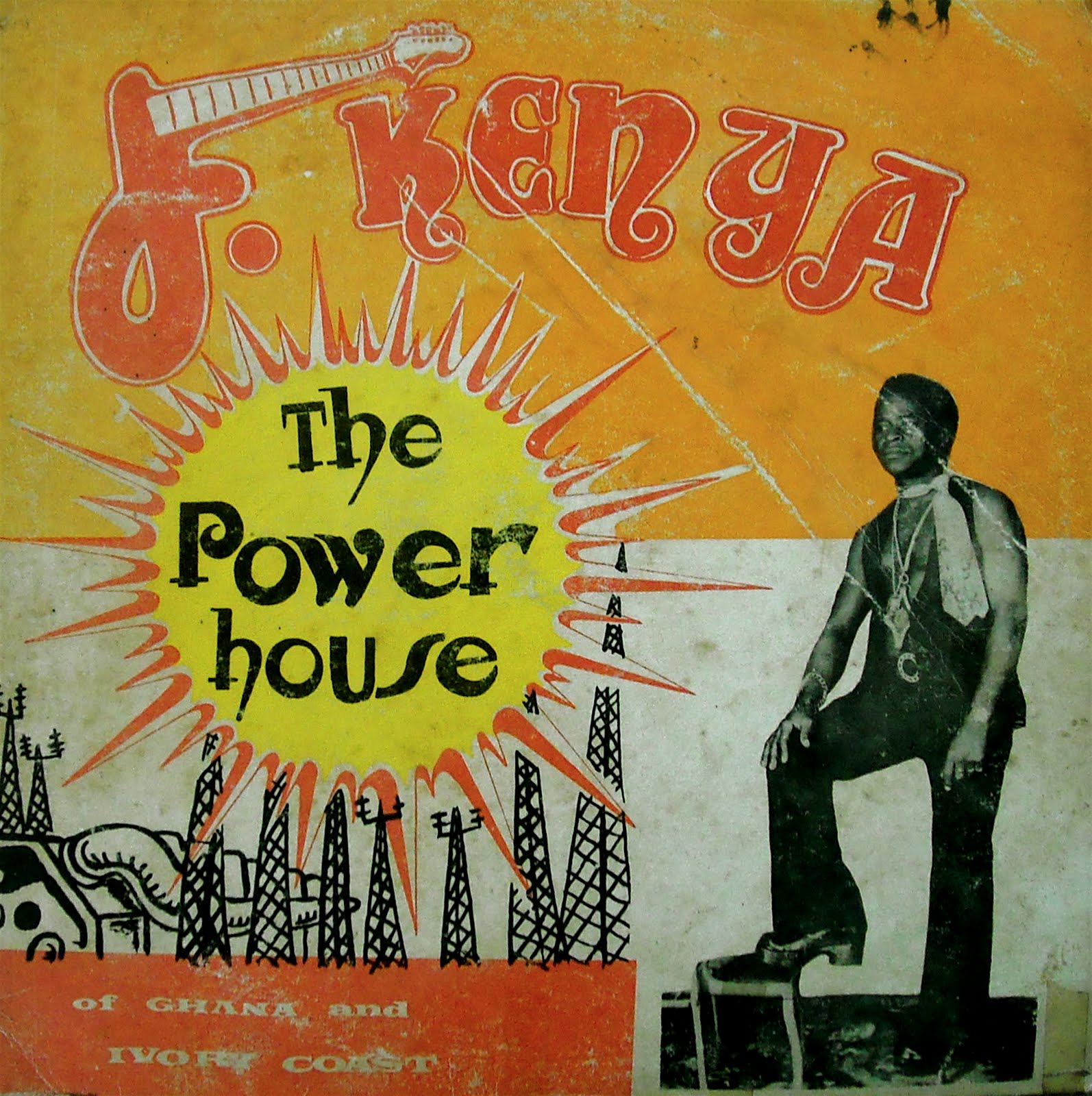
F. Kenya - The Power House (Essiebons, 1975)


The music of F. Kenya is (in my humble opinion) some of the most stunning Ghanaian highlife ever recorded, music with a unique sound characterized by deep Akan harmonies, sweet organs, and heartbreakingly beautiful vocals. The Power House, released on Essiebons in 1975, is Francis Kenya's first full length record. Like Kenya's other work, these songs are beautifully arranged, with rich musical textures that feature an interplay between interlocking guitar parts and organ lines. In addition, these songs are unique in that they are sung in Nzema (Kenya's own language) rather than the dominant Asante Twi (generally the language of highlife). The Nzema are an Akan ethnic group found on both sides of the Southern Ghana/Côte d'Ivoire border.  As in the context of other African countries, boundaries imposed by European colonizers frequently divided ethnically similar groups across arbitrary national borders.


F. Kenya - Mmamya Bie Mmamma


Below is a brief biography of F. Kenya from the back of this album:


Prof. John Collins of the University of Ghana, Legon shared a close relationship with F. Kenya, living in his home during the 1970s and travelling with Kenya's concert party troupe for some time. In addition, Collins recorded F. Kenya & his band at his Bokoor Studio.  Seven of these tracks may be found on the great compilations The Guitar and the Gun and Electric Highlife.


Enjoy!

Saturday, October 30, 2010

Adowa Music - Onyame Nkrabea Nwomkro


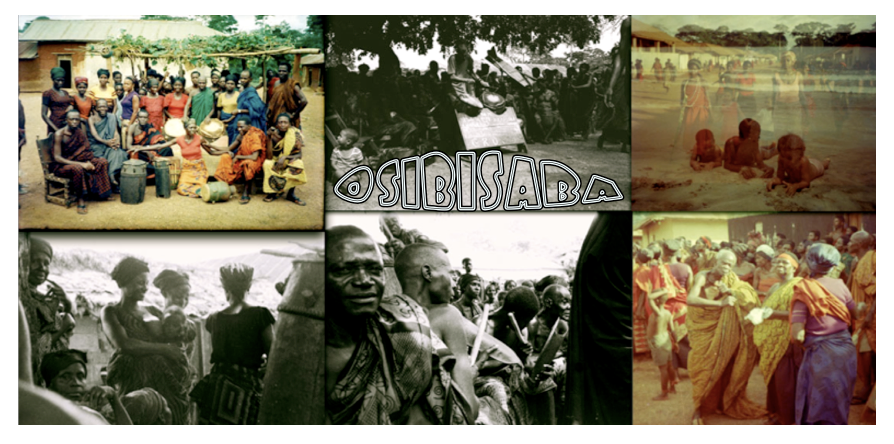
Moving away from popular music for the moment, I would like to present "Adowa," a traditional genre/dance of the Asante of Ghana.  Like other traditional music genres, Adowa combines drumming and percussion with dancing and call-and-response style singing. This music serves a profound social function, as Adowa is a dance that is performed at and often associated with funerals. Accordingly, song texts are frequently philosophical in nature, meditations on life, death, and humankind itself.

This particular recording by Onyame Nkrabea Nwomkro features three twenty-minute long tracks in medley style. The drummers maintain a minimal presence throughout, allowing the powerful chorus of singers to take the forefront. This music is beautiful and stunning, and I find myself totally absorbed in the complex melodic lines sung by the lead singers and the lead drummer's varied Atumpan phrases.


Please read below for some more detailed information on Adowa:


"The [Ensemble] includes one or two bells - dawuro (boat-shaped) or slit-type called adawuraa; one or two hourglass drums called donno; one sonorous drum played by the hand called apentemma; one tenor drum played with stick called petia; and a talking drum called atumpan.

With the exception of the bells which may be played by women, the rest of the instruments are played by men, while women form the chorus. Normally one of the bells is regarded as the 'primary' bell while the other bell functions as 'the bell that crosses.'

The hourglass drum plays something in simple duple thyrhms. Where there are two, the second one plays cross rhythm. The main function of the apentemma drums is to suply recurring high-pitched tones. The drummer works in patterns of low and high pitches. The basic rhythm of the peti is a simple 5-note phrase made up of alternating simple and duple rhythmic motif rather like the primary bell.

The atumpan is the most important of all the instruments in the ensemble. When the music starts, the drummer may first make an announcement of drums or give a short message of sympathy. Immediately after this, he may begin with first, the introductory rhythms, and then other rhythms follow, to give the dancer the opportunity to find his bearing or time. This could be followed by other rhythmic motifs, all these go to animate the dance."
- "African Music: Traditional & Contemporary," Alexander Akorlie Agordoh


The meaning of the word "Adowa" is interesting in itself. Adowa is the Asante name for the Royal Antelope (pictured right), one of the rarest and smallest of the antelope species (about the size of a house cat). This tiny animal is considered exceedingly graceful in its movements, and it is this type of graceful movement that Adowa dancers must imitate and express. The Adowa genre, then, is named after this small antelope.


I've already introduced the Atumpan drums briefly in this post. Played in pairs of two differently pitched drums, the Atumpan is used to express verbal phrases, proverbs, and appellations.  The experienced player is able to translate these speech patterns (many of which are set phrases) onto the Atumpan based upon the different tones of the Twi language.  In Adowa another layer of complexity is added. Here, the lead drummer plays set Adowa phrases on the Atumpan that correspond to specific dance actions. In effect, this drummer controls the dancers' steps and motions by playing through a commonly recognized repertoire of drum proverbs/phrases.
Saturday, October 16, 2010

T.O. Jazz - Agyeman Baidoo & Bonus Single


The highlife musician T.O. Jazz remains a bit of a mystery to me, but I've thoroughly enjoyed getting to know some of his old-time (sometimes palmwine-style) music through songs recorded & released by John Collins and also the few  albums I've been able to listen to. Any track by the late T.O. Jazz just seems special. Below you can listen to "Agyeman Baidoo," recorded at Collins' classic, now-defunct Bokoor Studio. I've also included some biography information, and a bonus single from T.O. Jazz at the bottom of the page. This one features T.O.'s long-time female singer Adjoa Badu, pictured below.

T.O. Jazz - Agyeman Baidoo. Download

Thomas Osei ‘Jazz”  Ampoumah comes from the town of Obomeng in the mountainous Akan Kwahu region between Accra and Kumasi.  Born in 1932 he started learning guitar when he was fifteen years old in the town of Nkawkaw. T.O began playing in public with friends in 1950 when he was just eighteen years old. He formed his Ampoumah’s guitar band Mpraeso in 1952 with Kwabena  Amoah (vocals), Kwaku Gyima (second guitar) and  Edmond Kye (congas).  T.O. made his  his first recordings  with a Ghana Broadcasting mobile van unit in 1954 and then with the UAC (United Africa Company) that had a small recording studio in Accra. In those days he was paid eight pounds per recording (i.e. two songs)

In 1957/8 his guitar band was on tour in Burkina Faso (then called Upper Volta) where he met the Congolese band the Bantus Africana  – who invited T.O. and his three musicians to Zaire where they played highlife numbers for the Bantus who were fascinated by this music but could not play it. The Bantus in turn taught the Ghanaians to play  local lingala rumbas, chachacha’s, meringues, pachanga and boleros  T.O. also met Franco the leader of Zaire’s top band O.K. and so changed the name of his Ampoumah’s guitar band to ‘T.O. Jazz’. When T.O. Jazz returned to Ghana in 1961 they introduced the chachacha to the country.

Back in Ghana he set the newly named T.O. Jazz band that specialized in highlifes and Akan renditions of the rumba.   It was with this band that T.O. recorded  in 1968 the hit song ‘Aware Bone Asu Manim Ase’ (Bad Marriage  Has Disgraced Me) that was released as a 45 RPM  on the Phillips label. For this T.O.  (together with Victor Uwaifo of Nigeria)  was awarded in  1970 the first Phillips West African Golden Discs – and went  to record a total of 127 songs. So by the mid 70’s T.O. Jazz was a household name in Ghana.  In 1996 T.O. began  teaching ‘palmwine highlife’ at  the Music Department of the University of Ghana, where he also played and sang with John Collins' Local Dimension Band.  T.O died after a short illness in 2001.
 
-http://www.nyu.edu/africahouse/forresearchers/bapmaf/tojazz.html


        Download


       1. Kasabrofo
       2. Ye Bewu Asee


Beware! This single is seriously crackly. Loud, scratchy sounds are consistent throughout, but I still find this music very enjoyable.

Sunday, September 12, 2010

Koo Nimo & Osei Korankye - Tete Wobi Ka


Here's another album of palmwine music by one of my favorite musicians, Koo Nimo. The record is Tete Wobi Ka (2000), and here Agya Koo is joined by Osei Korankye, another truly one-of-a-kind musician. Osei plays the Akan harp seprewa, the original instrument of Ghanaian palm-wine music (pictured last below). This is a particularly important instrument, as it is the style and playing technique of seprewa, translated onto the guitar, that has remained at the core of Ghanaian highlife from the 1920s through the 21st century. Osei is also a singer, and his tenor provides backing to Koo Nimo's deeper, resonant voice through much of this album (I'll be devoting another post to Osei in the coming weeks). 

Tete Wobi Ka doesn't appear to be commercially available any longer, so I've offered it here for download . Koo Nimo's excellent first album Osabarima is (I believe) still available commercially for purchase.

Below is a bit of biography on Koo Nimo himself: 

"World-renowned Palm Wine musician, guitarist Daniel Amponsah, best known by his stage name Koo Nimo is often referred to as the “National Treasure” of Ghana. Thought of as a “living legend” by many Ghanaians, Koo Nimo's music has been a very relevant source of musical inspiration and continues to be after 40 years of performance.

Apart from his early exposure to music by his parents and playing in local groups, particularly I.E.'s Band, Koo Nimo also studied classical guitar style, harmony, counterpoint etc. at various times, to enhance his musical appreciation. "I didn't want to be a Segovia. I wanted to be an African guitarist, using my technique to do justice to my own music which I understand better," explains Agya Koo, as he is generally known in Ghana. 

Although a great consumer of jazz music- from Charlie Parker, Duke Ellington, John Coltrane, Wes Montgomery, Count Basie through Antonio Carlos Jobim and Lorendo Almeida to Thelonius Monk- Agya Koo drew inspiration first from Ghanaian guitarist Kwabena Onyina. But as he explains, "I didn't, however, want to be a second-rate guitarist, hence my determination to dig into my past for a traditional sound which I have now fashioned." He has represented his country with his Adadam Agofama Group at several international arts festivals and has also toured extensively throughout Europe and America, where he shared the stage with Puerto Rico's Yomo Toro during a 1988 "Guitar Summit".

Notwithstanding his stature and popularity, both within and outside Ghana, Agya Koo remains a man of the people committed to re-exposing his countrymen, particularly the young, to their own folk music. His priceless music represents a living art form - not a museum showpiece." 

- http://homepage.ntlworld.com/latham/koonimo/afrofest.htm

Osei & Agya Koo

Thursday, September 9, 2010

Palmwine Music: Ayonko Asiwa Group - Koobi Awaree


Here's an album of beautiful "palmwine" music by the Ayonko Asiwa Group.  The record features two twenty-minute-long tracks in medley style, simple and perfect with just a few singers, guitar, and light percussion.  

You can download it here .


If you're interested, here's a brief bit of historical background on Ghanaian palmwine music from scholar John Collins:

In Ghana it was the Kru-taught musician Kwame Asare (Jacob Sam) whose Kumasi Trio made the first recordings of "palm wine music" in 1928 when they went to London to record for Zonophone. This session also included the first recording of the famous song "Yaa Amponsah" which provided one of the most enduring and important melodo-rhythmic riffs found in Ghanaian highlife.


Premprensua
When the costal Fante-style music moved inland into Asante and Kwahu during the 1930s it blended with the music of the local seprewa harp-lute. The result was a more Africanised or rather Akan variety of palm wine guitar music known as "Akan Blues" or "Odonson." It was sung in a recitative way rather than in structured verses using African modal progressions (between two tone centres a full tone apart) rather than the western harmonic progressions (I, IV, V chords) of the earlier costal style. These small palm wine guitar bands consisted of just one or two guitars accompanied by "clips" (i.e. claves), "Adakam" (wooden box as drum), and Gome (giant bass frame drum) or "Premprensua" (hand-piano).  

Koo Nimo, one of the truly great living palmwine musicians, gives his own perspective on the origins of this genre:

"Palmwine is a local drink. In villages you find, under a shady tree, in the afternoons old men would relax and be telling stories about life. Marriage experiences, disappointments. Now, at that time seprewa was the instrument, the African harp-lute. And the seprewa player might be sitting around, then a palmwine tapper would bring a pot of palmwine, usually identified  by the foam on top. Then the calabash is passed round and they drink of palmwine. Now the music that is played under that environment was called palmwine guitar music. In this way, acoustic and folklore Highlife music inherited its name from the fact that it gained its popularity at Palm Wine bars, which symbolically represented music of the masses."

If you're further interested in this music be sure to check out the "Vintage Palmwine" album (recorded and released by John Collins) featuring classic palmwine musicians T.O. Jazz, Kwaa Mensah, and Koo Nimo. 

Also, this album  by Kwabena Nyama will simply blow you away!