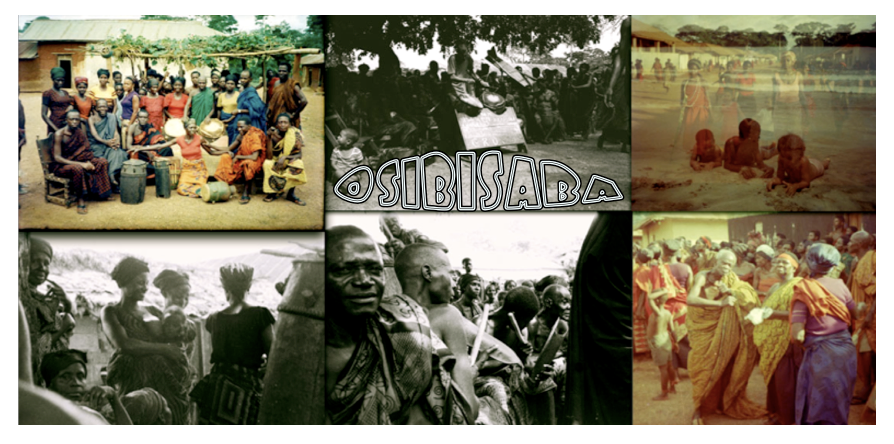
Here we have a short album by Kyeremateng Atwede and his Kyeremateng Stars entitled Owuo See Fie. "Owuo sei fie" is an Akan proverb which concerns the far reaching effects that a death may have on the family, roughly translated as "death spoils a house" or "death destroys a home." Accordingly, the "O" of the word Owuo (death) is filled in here with an ominous image of a skull. On this album, Kyeremateng Atwede and his group present three beautiful & deep Akan guitar-band style songs, with a counterbalance of two upbeat highlife tunes sung in Pidgin English ("Every Work Na Work" and "Yellow Woman").
Fidie Wura by Akwaboa's Band is a beautiful, laid-back gem of an album. The songs featured on this record are smooth and effortless, with rootsy harmonies, acoustic guitar playing, and singing characteristic of traditional Akan music and palm wine highlife. All of Akwaboa's recordings are excellent, but this album really wonderfully demonstrates the intimate relationships which exist between electric guitar-band highlife, palm wine, and traditional Akan music. And what a great album cover too!
Several posts back, I briefly mentioned a rendition of a traditional flute dirge played on the organ on a track from the African Brothers' album Tribute to D.K. In light of that comment I thought that I would take some time here to discuss the genre of funeral dirges for flute. Traditional flute music in Ghana is exceptionally beautiful, and dirges in particular are especially soulful and stirring. I've selected three videos from youtube which feature different performances of flute dirges. These performances occur in the context of funerals and mourning.
In the first two videos, dirges are played on the atenteben, a diatonic bamboo flute which was developed by composer/professor Dr. Ephraim Amu in the 1920/30s. The atenteben also appears in highlife music, from '70s bands Wulomei and Hedzoleh Soundz to modern groups like Hewale Sounds and the Pan-African Orchestra.
The third video features Nana Yaw Opoku Mensah, once a flautist in the court of the Asantehene, playing the traditional Akan odurugya flute. In contrast to the atenteben, the odurugya is a notched flute with a deep bass tone, built from the inner cane of the bamboo stalk. Like the Akan atumpan drums, flute dirges imitate the tonal contours of the Twi language. In this way, flute dirges may be conceived of as a musical recitation of a spoken text. Read more about the atenteben and odurugya in this short writing by Professor J.H. Kwabena Nketia HERE.
"The flute is often used in songs of lamenting or grief. This piece is more of a recitation than a song, for the odurugya is a 'talking' instrument, which means that the Akan of antiquity developed a system of encoding their language into the range of sounds/tones the odurugya makes. One must be immeresed in the 'deep structures' of Akan society in order to learn the method of 'decoding' the flute language."
In conclusion, I offer a short recording of an odurugya dirge from Ephraim Amu's University of Ghana Chorus record. Thank you to the individuals who posted these wonderful videos of traditional flute music from Ghana.
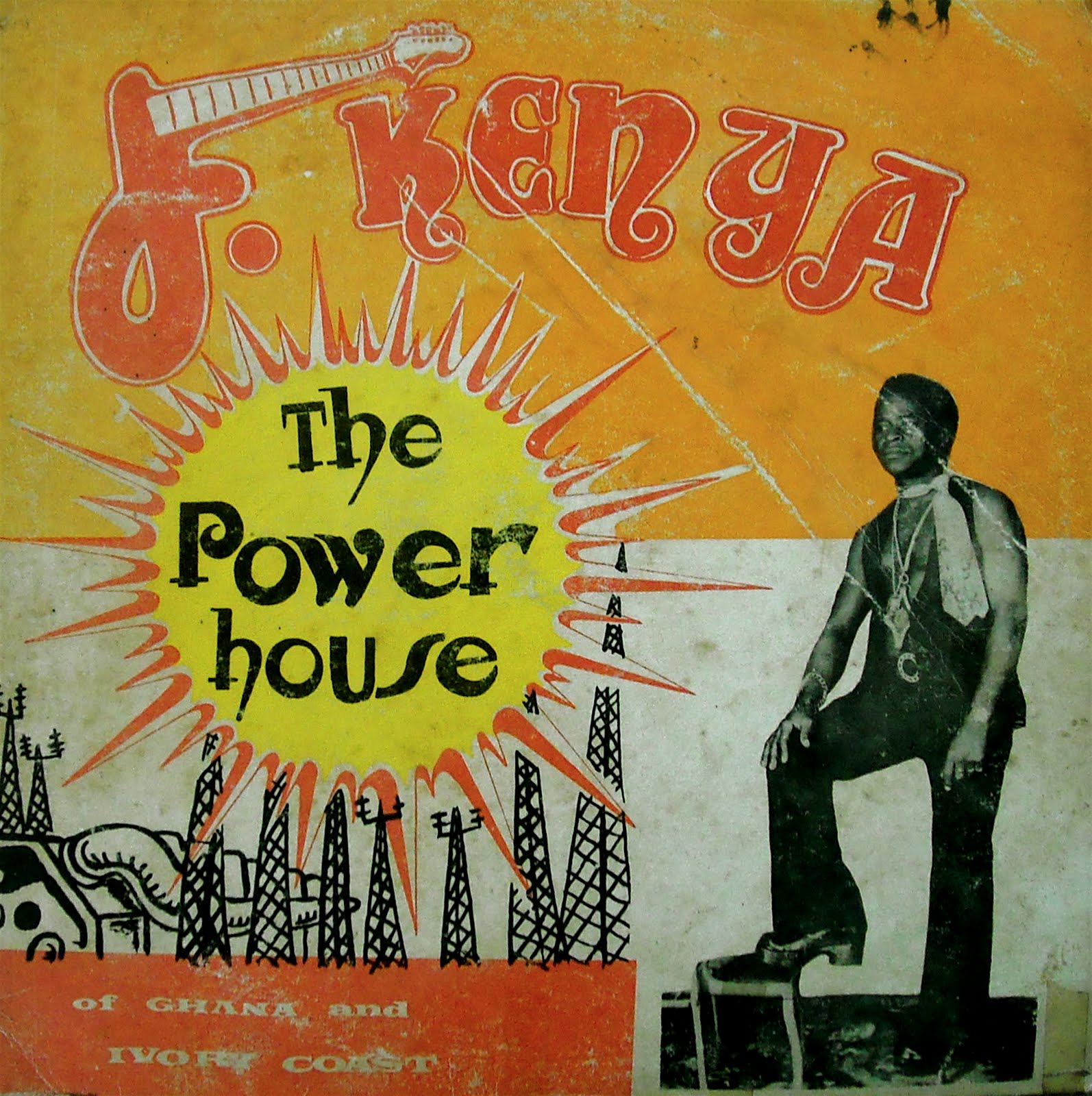
The music of F. Kenya is (in my humble opinion) some of the most stunning Ghanaian highlife ever recorded, music with a unique sound characterized by deep Akan harmonies, sweet organs, and heartbreakingly beautiful vocals. The Power House, released on Essiebons in 1975, is Francis Kenya's first full length record. Like Kenya's other work, these songs are beautifully arranged, with rich musical textures that feature an interplay between interlocking guitar parts and organ lines. In addition, these songs are unique in that they are sung in Nzema (Kenya's own language) rather than the dominant Asante Twi (generally the language of highlife). The Nzema are an Akan ethnic group found on both sides of the Southern Ghana/Côte d'Ivoire border. As in the context of other African countries, boundaries imposed by European colonizers frequently divided ethnically similar groups across arbitrary national borders.
F. Kenya - Mmamya Bie Mmamma
Below is a brief biography of F. Kenya from the back of this album:
Prof. John Collins of the University of Ghana, Legon shared a close relationship with F. Kenya, living in his home during the 1970s and travelling with Kenya's concert party troupe for some time. In addition, Collins recorded F. Kenya & his band at his Bokoor Studio. Seven of these tracks may be found on the great compilations The Guitar and the Gun and Electric Highlife.
I would like to direct you to the blog "Bentleyfunk," which recently posted a copy of the African Brothers' album Tribute to D.K last week. This album has been on my mind recently, and I figured many readers might not be aware of its availability online. Founder of such Ghanaian record labels as Obobua, Aduana, and Happy Bird, D.K. Nyarko served as the producer of the African Brothers Band starting in 1967. This album was recorded after Mr. Nyarko's death, and features four subdued & emotional songs dedicated to him. Of particular note is the deep "Kyeremirekuku" and an unusual rendition of a traditional flute dirge played on the organ at the beginning of the third tack. Please enjoy this absolutely wonderful album.
African Brothers Band - Ma Me Nsu Ma Wo
D.K. Nyarko
Update: As Moos has kindly pointed out, the blog Bentleyfunk seems to no longer exist. I've uploaded the original download from this now defunct blog. Download Tribute to D.K. HERE.
Lately I just can't get enough of this "Nigerian-ized" Ghanaian highlife music. Many great highlife albums were recorded in the 1970s and '80s by Ghanaian bands either living in Nigeria (such as Okukuseku) or aiming to target West African markets outside of Ghana. The music that these types of groups created has a particular feel and sound; it is practically unique enough to be categorized within its own genre. Rhythms, guitar riffs, and melodies reflect influences from within, as well as outside of Ghana. At the same time, many songs are sung in Pidgin English in addition to local Ghanaian languages (like the title track on this album). In this way songs were made intelligible to Nigerian listeners.
Hello there! I apologize for the long gaps between posts around here lately. To make up for this, I offer one of my favorite highlife albums, Ogyatanaa's Yerefrefre (this record also might just have one of the best covers ever!).
The Ogyatanaa (or "burning torch") Show Band was founded in 1971 by Kwadwo Donkoh, a former diplomat turned highlife musician and record producer. I don't have much information about Donkoh, yet I consider him one of the big names in Ghanaian highlife, a behind-the-scenes figure and master arranger/composer. In addition to his work with Ogyatanaa, Donkoh founded Agoro records in the early 1970s. Agoro released diverse popular and traditional records, and later it would introduce the first albums by Ga cultural groups like Wulomei.
On this first album by the Ogyatanaa Show Band, we have classic tracks like "Mmobrowa" and a funky "Yaa Amponsah," yet my absolute favorite here is the "Yerefrefre" medley on side one, a twenty minute long track which pays tribute to Ghana's highlife greats. Musicians like E.K. Nyame, C.K. Mann, King Onyina, E.T. Mensah, Nana Ampadu, and K. Gyasi are acknowledged, while hit songs by these artists are also "quoted" throughout the medley. The group switches rapidly between songs, offering snippets of such tunes as E.T. Mensah's "All for you" and the Black Beats' "Lai momo."
In honor of "One Man Thousand" Alex Konadu who passed away last month (see obituary in previous post), I offer you this 1983 album Dua Ayi Me. Here we have Konadu at his finest, joined by B.B. Collins Marfo of "Powerful Believers" fame on lead guitar and backing vocals.
Also, be sure to check out Alex Konadu's first album Nsa Dwa Se, which was recently posted over at Global Groove. Enjoy!