 |
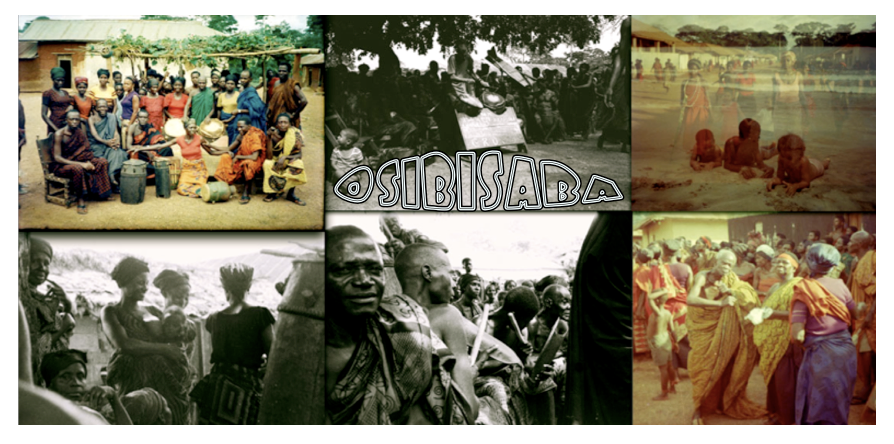
| Top from left to right: Leader Nii Tei Ashitey with osrama drum, lead singer Maa Amanua, and Nii Adu "Big Boy" on gome drum. |
Ga cultural highlife emerged during the 1970s as an urban, neo-traditional popular music form. The Gas are an ethnic minority in Ghana (where Akans dominate over forty percent of the population) yet they remain the majority in Ghana’s capital Accra, as they are the city’s oldest, original inhabitants.
 This ethnic group is primarily bound to the costal and the urban realms, as the sea (in particular fishing) has played a central role in livelihood up until the present. Ga musicians were involved in dance-band highlife since the early 20th century (this variety of highlife accordingly reflects influences from Ga traditional music), yet it was not until the cultural highlife of the 1970s that Gas put forth their own style of guitar-band music. This new music represented a desire to go “back to roots” and revive tradition.
Ga cultural highlife was largely the creation of drummer Nii Tei Ashitey, who founded the pioneering Ga highlife group Wulomei in 1973. Both a traditional and dance-band drummer, Ashitey founded Wulomei as a reactionary move against the influx of foreign music into Ghana. He states his objective as “To bring something out for the youth to progress and to forget foreign music and do their own thing” (Collis, Musicmakers 142). Inspired by the proto-highlife Ga konkoma groups of the 1940s, the music of Ashitey’s Wulomei encorporates influences from Ga traditional music, Kru sea shanties, work songs, and Akan guitar-band music. Wulomei’s original sparse lineup consisted of traditional percussion instruments (bells, rattles, drums), a single guitar, and a chorus of several male and female singers. Here, the percussion section is emphasized heavily, while singing is modeled after the group call and response singing of a traditional dance/drum ensemble both in terms of form and vocal technique. Accompanying the chorus of singers is the guitar, adding a highlife dimension to a style which might otherwise sound very much like traditional music.
 |
| Nii Adu (AKA "Big Boy") playing Gome |
Wulomei - Menye Menye
Walatu Walasa (1974) is Wulomei's second album, following Mibe Shi Dinn released earlier that same year. Released on Kwadwo Donkoh's Agoro records label, Walatu Walasa features many of Wulomei's biggest hits, including "Akrowa," "Kaafo," and the title track. John Collins writes: "Walatu Walasa means in Twi that 'you are digging and then shoveling it away,' implying that only an idiot would do both. Walatu Walasa has become a popular phrase at a time when large numbers of workers have been employed by the government to build drains in Accra. To greet a laborer with this term is to insult him, for it demeans manual labor" ("Ghanaian Highlife" p. 67). These Wulomei songs (and those of other Ga groups like Dzadzeloi, Suku Troupe, Ashiedu Keteke, Abladei, etc.) continue to be relevant and popular in Ghana today, where they may be heard playing over the radio and from street-side speakers in Accra. At the same time, Wulomei remains in existence with a lineup of all new members, now lead by Ashitey's daughter and son.
Download Walatu Walasa
 |
| Female singers of Wulomei |

 The deeper I go into this music, African music, the more I fall in love, and the more I want to share it with as many people as possible. This blog is an attempt to do just that. Here, my posts will focus mainly on Ghanaian music in its many rich forms, from Highlife, Gospel and Hiplife to the work of composers like Kwabena Nketia and the tremendously diverse array of traditional music styles. In addition to old albums I plan to post videos, photos, text from books, and any other small findings from the net you might find interesting.


